
This is not a story about glorifying Pablo Escobar
Finca La Manuela is one of the most unusual historical sites in the Guatapé–El Peñol reservoir region: ruined walls beside a spectacular body of water, once the property of the most infamous drug trafficker in Colombian history. It is worth understanding, not because Pablo Escobar deserves celebration, but because the ruins are a physical connection to one of the most violent and consequential periods in modern Colombian history.
La Manuela sits at the intersection of several histories: the reservoir that reshaped El Peñol and Guatapé, the rise of the cocaine trade, Escobar’s attempt to turn criminal wealth into political power, the terror the Medellín Cartel inflicted, the campaign to destroy him, decades of legal battles over confiscated property, and the state’s recent effort to turn a notorious criminal asset back into legitimate value. Today it is open to visitors again. Understanding the ruins means understanding all of that.
Quick Visitor Facts
OPERATOR DETAILS CHECKED AUGUST 2026. Prices, hours and access change, and some details are set by a private operator, so confirm directly before travelling.
| Where it is | Vereda El Uvital, municipality of El Peñol, on the El Peñol–Guatapé reservoir. Marketed via Guatapé. |
| General admission | From about COP 30,000 per person (recent operator listing). Confirm current price before visiting. |
| Historical guided visit | About COP 45,000 per person, roughly 45 minutes. Transport and food not included. |
| Hours | Business listing shows about 9:00 am to 6:00 pm daily. Confirm before travelling. |
| Getting there | Lancha (boat taxi) from the Muelle Único in Guatapé, or by rural road on the El Peñol side. Arrange your return in advance. |
| Operator | Run by D’Groupe as Parque La Manuela (lamanueladventure.com). The operator is not necessarily the legal owner (see below). |
| Good to know | The site now mixes history with adventure activities, so the experience is no longer purely historical. |
Pablo Escobar Before La Manuela
Pablo Emilio Escobar Gaviria was born on December 1, 1949, in Rionegro, Antioquia, not far from the region where La Manuela would later be built, and grew up around Medellín and Envigado. Biographical accounts describe him as one of seven children of a schoolteacher and a farmer. Many colorful stories cling to his youth, but they are hard to separate from the mythology that later surrounded him.
What is not in dispute is the trajectory. By the 1970s Escobar was moving through Antioquia’s criminal underworld exactly as cocaine was becoming extraordinarily profitable, and through the 1980s he became the most notorious figure in the loose federation of trafficking organizations known as the Medellín Cartel. It is a mistake to picture the cartel as a single company with Escobar at the top of an org chart: DEA historical records describe several separate organizations cooperating in production, transport and distribution. Escobar became the most dominant personality, but not the only important one. What set him apart was combining criminal wealth with political ambition, social patronage, intimidation and spectacular violence.
From Criminal Wealth to Political Power
Escobar understood that money could buy more than houses and land: it could buy legitimacy. He cultivated an image as a benefactor in poorer communities while building an organization able to bribe, threaten and kill anyone who interfered. In 1982 he entered Colombia’s Congress as an alternate representative for Antioquia. His political career was short. Justice Minister Rodrigo Lara Bonilla became one of his most prominent adversaries and helped expose his trafficking ties; Escobar was pushed out of national politics, and Lara Bonilla was assassinated in April 1984 in an attack attributed to Escobar’s organization.
From there the conflict with the state escalated around one issue: extradition to the United States. Escobar and allies who called themselves Los Extraditables set out to make extradition politically unbearable. Judges, police, journalists and politicians were murdered; bombs exploded in public places; presidential candidate Luis Carlos Galán was assassinated in 1989. On November 27, 1989, Avianca Flight 203 exploded shortly after leaving Bogotá, killing all 107 people aboard; U.S. Justice Department records attributed the bombing to Escobar’s organization. This is essential context for La Manuela: the money that produced extravagant estates was not separate from this violence. They were the same system.
La Manuela Appears on the Reservoir
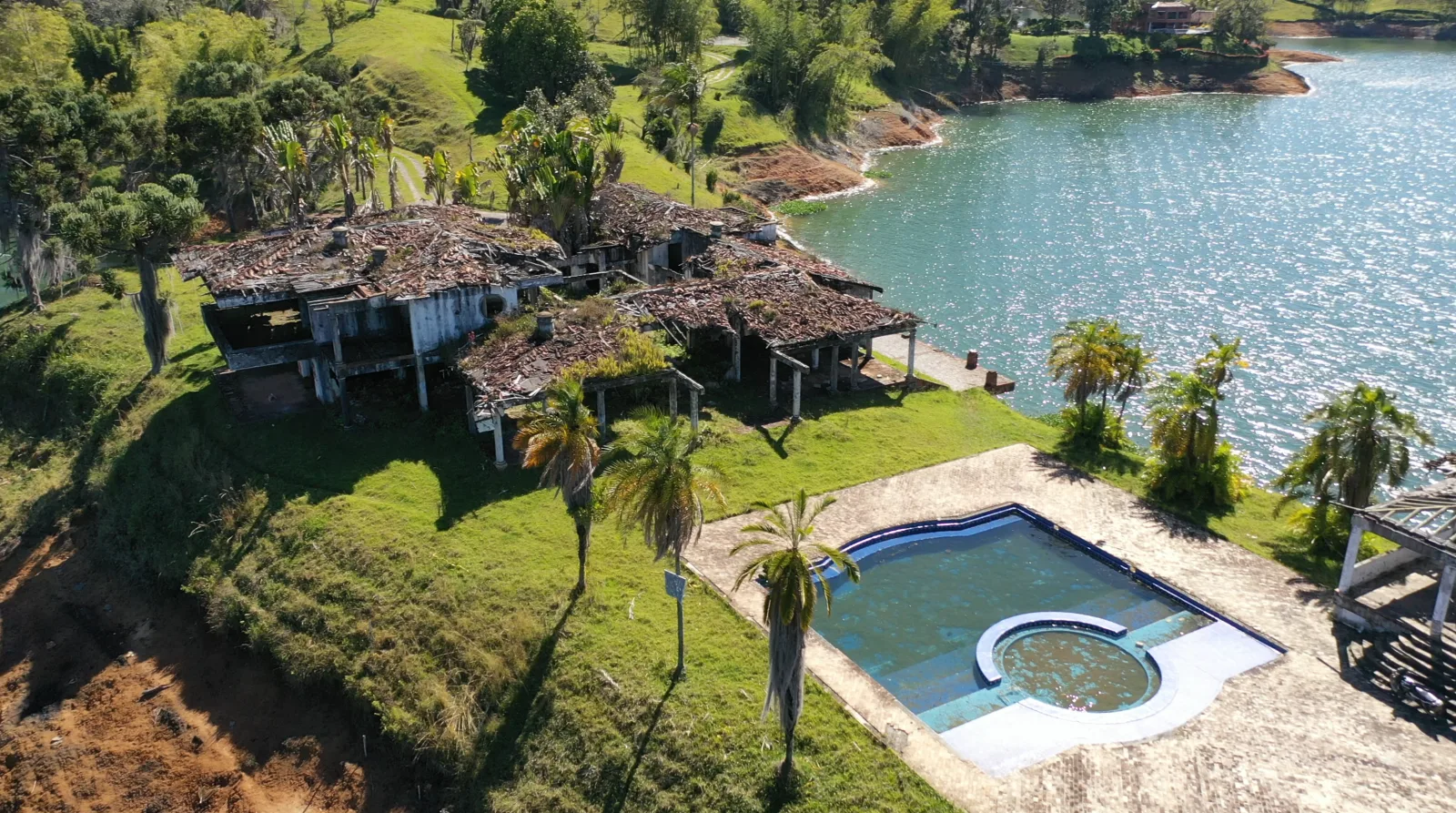
Escobar began developing La Manuela in the mid-1980s, after the hydroelectric reservoir had already transformed the landscape of El Peñol and Guatapé. The estate was placed among the water, hills and island-like geography the project created. Reports describe a main residence, guest areas, a swimming pool, stables, sports facilities and landscaped grounds, with ornamental trees and plants reportedly brought from as far as Africa, Europe, Chile and the United States.
Even the property’s size shows how loosely its history is repeated. Some reports describe roughly eight hectares; others, citing SAE figures, mention 7,826 square metres associated with the property alongside a larger total estate approaching 14 or 15 hectares, while the current attraction promotes around 80,000 square metres of visitor territory. These figures may describe different cadastral, built or operating areas, so we should not pretend they all measure the same thing.
Was La Manuela Really Built for His Daughter?
One of the most repeated stories is that Escobar named the property after his daughter Manuela and intended it as a gift, often described specifically as a gift for her fifteenth birthday. That story may be true. But it should be presented as an account handed down through guides and people connected to the property, not as conclusively documented fact. In its 2026 reconstruction of La Manuela’s history, El Espectador was careful to identify the quinceañera version as one transmitted by guides and former workers. That distinction matters, because tourism has a way of turning interesting stories into certainty. We should not.
Did Pablo Escobar Actually Live Here?
Here the record is murky. Some accounts say the estate was never officially completed or inaugurated, and that Escobar never really got to enjoy the finished property before it was destroyed; El Espectador reports guides saying some furnishings had not even been installed. Other reporting, including El Tiempo, describes it as a place the family used and stayed at.
The responsible conclusion is neither “Escobar definitely never stayed here” nor “this was one of his favorite homes.” The evidence supports something more careful: La Manuela was unquestionably a property associated with Escobar and his family, but the exact degree to which he personally occupied the unfinished estate before its destruction is obscured by conflicting accounts.
Luxury on the Edge of a War
While La Manuela was being developed, Escobar’s rise was already collapsing. Cartel figures were arrested, killed or surrendered, and Escobar negotiated his own surrender in June 1991, confined in a prison outside Medellín known as La Catedral. Calling it a normal prison is misleading: he kept extraordinary control of the facility and, according to DEA records, continued approving cocaine shipments and ordering murders from inside. When authorities tried to move him to a conventional prison in July 1992, he escaped, beginning a sixteen-month manhunt, and creating the conditions that would destroy La Manuela.
Los Pepes
Escobar had enemies far beyond the government: former associates, rival traffickers, victims and paramilitary figures. During the manhunt, a clandestine group calling itself Los Pepes (Perseguidos por Pablo Escobar, “People Persecuted by Pablo Escobar”) began attacking his associates, lawyers, businesses, family networks and properties.
The history of Los Pepes is uncomfortable because the line between organized crime, paramilitary violence and parts of the anti-Escobar effort was not clean. Declassified U.S. documents later revealed intelligence links between Colombian security personnel and figures associated with Los Pepes; the National Security Archive documented evidence that the Search Bloc shared information with paramilitary leader Fidel Castaño, and U.S. concern at the time about those contacts. Escobar was being hunted not only by the state but by enemies using many of the same violent methods as his own organization. La Manuela became a target.
February 1993: La Manuela Is Destroyed
In February 1993, explosives were placed at La Manuela. El Colombiano’s historical reconstruction places the attack on the night of February 17, 1993; other accounts simply date it to February of that year. Los Pepes are widely identified as responsible. The blast and the destruction that followed devastated the property, leaving the main residence and other structures ruined. Images of the shattered buildings became one of the enduring visual symbols of Escobar’s collapse.
The destruction is sometimes presented to tourists almost like a scene from a film. It was not. It was one act inside an extremely violent struggle of bombs, assassinations, kidnappings and retaliatory killings across Colombia. The ruins are not merely “cool abandoned buildings.” They are physical evidence of that conflict.
Pablo Escobar’s Final Months
By the time La Manuela was attacked, Escobar’s world was shrinking fast: Los Pepes were dismantling his network, police were hunting him, former allies had turned, and the cartel was fragmenting. On December 2, 1993, one day after his forty-fourth birthday, Colombian police located him in Medellín. DEA accounts say directional-finding equipment helped fix his position; Escobar and a bodyguard tried to flee across adjoining rooftops and were shot and killed by the Colombian National Police.
Escobar was dead. The criminal economy that produced him was not. A 1994 DEA analysis warned that the Medellín cocaine trade did not vanish with him: other traffickers reorganized, trafficking continued, and new groups emerged. That is why the popular story, “Escobar died and the cartel era ended,” is too simple.
The Caretaker Years and State Forfeiture
One of the most interesting parts of the story begins after Escobar disappears. A worker named William Duque had arrived around 1991 as a gardener and became the property’s caretaker, or mayordomo. With Escobar gone and the family absent, Duque stayed, effectively becoming the human guardian of the ruins. Tourism gradually arrived, drawn by the legends, and over time Duque built tourism activities around the site, including a restaurant-bar.
But the property was not his. A process of extinción de dominio (forfeiture of assets connected to criminal proceeds) transferred ownership to the Colombian state; El Tiempo reported a judgment establishing state ownership in 2005. Duque sought legal recognition of possession, and the courts rejected the claim, confirming that La Manuela belonged to the state rather than its longtime caretaker. In April 2019 the Sociedad de Activos Especiales (SAE), the agency that administers forfeited assets, removed Duque and took effective control, with the property placed for a time under the administration of the municipality of El Peñol.
Is La Manuela in Guatapé or El Peñol?
Visitors constantly hear “Pablo Escobar’s house in Guatapé,” and the attraction markets heavily around Guatapé. The more precise answer comes from municipal and recent reporting: Caracol Radio and El Tiempo place the property in Vereda El Uvital, municipality of El Peñol, on the reservoir shared with Guatapé, and El Peñol’s planning documents list La Manuela as a municipal tourism asset reached by the El Morro–Uvital rural road.
The Guatapé label is understandable: the reservoir is branded internationally as Guatapé, and one of the easiest approaches is by boat from Guatapé. But the most defensible wording is that La Manuela is in the El Peñol–Guatapé reservoir region, in the rural El Uvital area associated administratively with El Peñol, while much of its tourism access and marketing is connected to Guatapé. That gives both towns their proper place. It is the same municipal nuance you will find at La Piedra del Peñol, which straddles the same El Peñol–Guatapé question.
From Ruins to Attraction: the Concession and the 2026 Sale
Two separate things happened here, and they are easy to confuse. First, SAE granted a private entertainment company, D’Groupe, the right to commercially exploit La Manuela under a concession reported to last twenty-five years. The concept went well beyond historical tours: reusing the swimming pool and helipad, and adding paintball, ATVs, buggies and other adventure activities. D’Groupe runs the site today under the “Parque La Manuela” brand.
Second, and separately, the state sold the property itself. At the start of 2026, SAE sold La Manuela through public auction for approximately COP 7.7 billion, with the auction closing at the end of December 2025. The buyer’s identity was not disclosed: El Tiempo and Infobae both reported a buyer whose identity has not been revealed, noting only that the party was Colombian and legally vetted by SAE. Reporting does not clearly explain how the operating concession and the property sale fit together. Local speculation has suggested people connected to the tourism operation may have acquired it, but as of early 2026 that remained unconfirmed. So an important distinction holds: the company operating tourism at La Manuela (D’Groupe) should not automatically be described as the legal owner unless that ownership is independently confirmed. The park is operating; the purchaser remains undisclosed.
La Manuela Today
As of August 2026, La Manuela functions as a history-and-adventure attraction, run by D’Groupe as Parque La Manuela. The operator advertises a general admission from around COP 30,000 per person (self-guided, roughly 30 minutes) and a historical guided visit around COP 45,000 running about 45 minutes; transport and food are not included in those basic products. The site also promotes adventure activities such as buggies, ATVs, jet skis, horseback rides and paintball, so it is no longer a purely historical visit. Its public listing shows daily hours of roughly 9:00 am to 6:00 pm and the phone +57 313 741 7239. Because hours, admission products and transport arrangements can change, confirm directly before leaving. This is now a functioning tourism operation, not simply abandoned ruins.
How to Get to Finca La Manuela
There are two practical approaches: by water from Guatapé, and by road through the El Peñol side of the reservoir.
By boat from Guatapé
For most visitors staying in Guatapé, the most natural approach is across the reservoir. The operator says visitors can take a lancha taxi from the Muelle Único in Guatapé. As with most reservoir boat taxis, a lancha may wait until it has enough passengers before departing, so allow some flexibility. This is probably the most rewarding way to arrive, because the reservoir is part of La Manuela’s story, and the water approach shows exactly why the location was chosen. Do not assume a private boat is waiting at all times: confirm the departure arrangement and, just as importantly, the return, before leaving the dock.
By road through El Peñol
La Manuela can also be reached by land. Because the route is rural, the operator recommends reserving in advance so it can coordinate the exact access point and timing. The property sits a few kilometres from the urban area of El Peñol on the rural El Morro–Uvital route identified in the municipality’s planning documents. Rather than trusting a generic map pin, confirm the current entrance and road approach with the attraction before setting out.
From Medellín
Coming directly from Medellín is roughly a 1½ to 2 hour drive, depending on traffic and conditions. For Guatapé Guide readers, though, there is a better way to think about it: come to Guatapé or El Peñol first. La Manuela makes far more sense as part of a Guatapé–El Peñol visit than as an isolated rush from the city. See our guide to getting to Guatapé for the region approach.
How Much Time Should You Allow?
The historical guided component is advertised at around 45 minutes, but that is not the whole visit. Allow extra time for boat or road transport, waiting for a boat to fill, walking the property, photographs, taking in the ruins, and any activities you add. You can treat La Manuela as a quick historical stop, but if you actually want to understand what happened here, rushing through it defeats much of the point.
What Are You Actually Looking At?
Walking through La Manuela, the important question is not “where did Escobar sleep?” It is: what does this place tell us about Colombia during this period? You are looking at the remains of wealth created by an international cocaine economy; at a property built when criminal organizations had enough money to challenge institutions, corrupt officials and wage war on the state; at ruins produced by another violent organization fighting Escobar; at land confiscated by the state; at a site that spent decades trapped between abandonment, private occupation, legal disputes and narcotourism; and now at a privately operated attraction on a property the state finally sold in 2026. All of those layers are La Manuela.
Documented History vs Tourism Mythology
Approach some of the stories told here with curiosity rather than automatic belief. There are persistent tales of hidden money, secret tunnels, extravagant parties, particular horses, specific rooms and exactly who slept where. Some may hold truth; some came from people who genuinely worked here; some have passed through decades of guide-to-guide retelling; and some are part of the global Escobar mythology.
We make a deliberate distinction. Documented fact means the claim traces to legal records, state agencies, credible reporting or multiple independent sources. Reported local history means it comes from former employees, residents or guides, and we say so. Legend or unverified claim means exactly that. That does not make the stories less interesting. It makes them more honest.
Is Finca La Manuela Worth Visiting?
Yes, for travellers interested in modern Colombian history, the reservoir landscape, unusual ruins, and understanding the Escobar period in physical context. The water approach alone makes it a memorable half-day from Guatapé. But be clear-eyed: the site today mixes history with adventure activities, so the experience is no longer purely historical, and visitors looking only for Escobar mythology may find our treatment more sober than a commercial narcotour. If your interest is genuinely the history, that sobriety is the point.
Visiting La Manuela Responsibly
Go because the location is fascinating, the reservoir approach is beautiful, the ruins are unusual, and this period changed Colombia. Understanding history is different from pretending it never happened. But do not mistake wealth for greatness, and do not let a story about Pablo Escobar erase the Colombians who paid the price for the world he created: the police, judges, journalists and political figures who were murdered, and the civilians killed in bombings, including the 107 people aboard Avianca Flight 203.
La Manuela is not the story of Pablo Escobar’s greatness. It is a story of impermanence. A man turned criminal wealth toward acceptance and power, terrorized those who resisted, and built spectacular properties; his enemies blew this one apart before he could enjoy it; he died months later on a Medellín rooftop; his caretaker remained; the state took the land; the courts kept it public; a municipality hoped to make it useful; an operator made it an attraction; and in 2026 the state sold it. More than thirty years after his death, visitors still cross the reservoir to walk through his ruins. Perhaps that is the lesson: the walls outlasted the power that built them.
Frequently Asked Questions
What is Finca La Manuela?
A former property of Pablo Escobar in the El Peñol–Guatapé reservoir region. He developed it in the mid-1980s; it was destroyed by explosives in 1993, spent decades under a caretaker and then state control, and now operates as a history-and-adventure attraction.
Is La Manuela in Guatapé or El Peñol?
Administratively it is in the rural El Uvital area of El Peñol, on the reservoir shared with Guatapé. Most access and marketing runs through Guatapé, which is why it is often called Escobar’s house in Guatapé, but the precise location is El Peñol.
Can you visit Finca La Manuela today?
Yes. As of 2026 it operates as a functioning attraction with a historical guided visit and adventure activities. Admission products, hours and access can change, so confirm directly with the operator before travelling.
How do you get to La Manuela from Guatapé?
The most natural way is by lancha (boat taxi) across the reservoir from the Muelle Único in Guatapé. It can also be reached by rural road via the El Morro–Uvital route on the El Peñol side. Arrange your return before setting out, especially by boat.
How much does La Manuela cost?
Recent operator information listed general admission from around COP 30,000 and a historical guided visit around COP 45,000, with the guided history about 45 minutes. Transport and food are separate. Prices change, so confirm current rates before visiting.
Did Pablo Escobar actually live at La Manuela?
Accounts conflict. Some say the estate was never fully finished before it was destroyed; other reporting says the family used and stayed at it. It was unquestionably associated with Escobar and his family, but the degree to which he personally occupied the unfinished estate is obscured by conflicting accounts.
Was La Manuela built for Escobar’s daughter?
That is a widely repeated account from guides and former workers, who say he named it after his daughter Manuela and meant it as a gift. Treat it as reported local history, not documented fact.
Was La Manuela destroyed by Los Pepes?
The property was destroyed by explosives in February 1993, and Los Pepes (Perseguidos por Pablo Escobar) are widely identified as responsible. It was one act inside the violent struggle to dismantle Escobar’s organization.
Who owns La Manuela today?
The Colombian state, through the SAE agency, sold La Manuela at public auction in early 2026 for about COP 7.7 billion, to a buyer whose identity was not disclosed. Separately, the entertainment company D’Groupe holds a 25-year concession to operate tourism at the site as Parque La Manuela. The operator should not be assumed to be the legal owner unless independently confirmed.
Is visiting La Manuela considered narcotourism?
It can be, if the visit is only about Escobar’s wealth and celebrity. It does not have to be. Approached as history, the ruins are physical evidence of a violent, consequential period, and understanding that is different from celebrating the man who financed them.