
Between Guatapé and San Rafael, the road climbs through a corridor of Andean forest, cloud forest edge, reservoir inlets, and rural farmland that most visitors never enter. This is where the biological richness of the region concentrates. The reservoir created a patchwork of habitat — islands of forest, water margins, secondary growth — that supports an extraordinary density of birds. The hills behind town hold monkeys, glass frogs, and Andean singletrack that goes deeper into the landscape than any road.
This page is for the visitor who came for La Piedra and realized there was more.
Bird diversity
Colombia is the most bird-rich country on earth. The zone around Guatapé sits in a transition band between the Western and Central Andes ranges, which produces the elevation gradients and habitat variety that drive avian diversity. You don’t need to go far or spend much to see serious birds here.
Species you’re likely to see
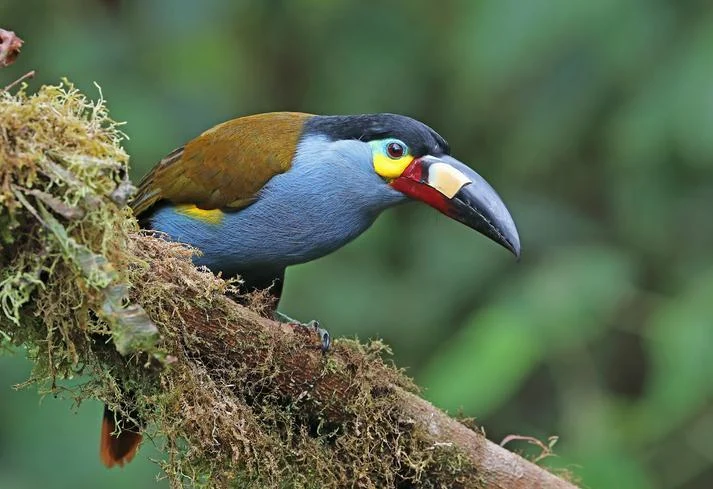
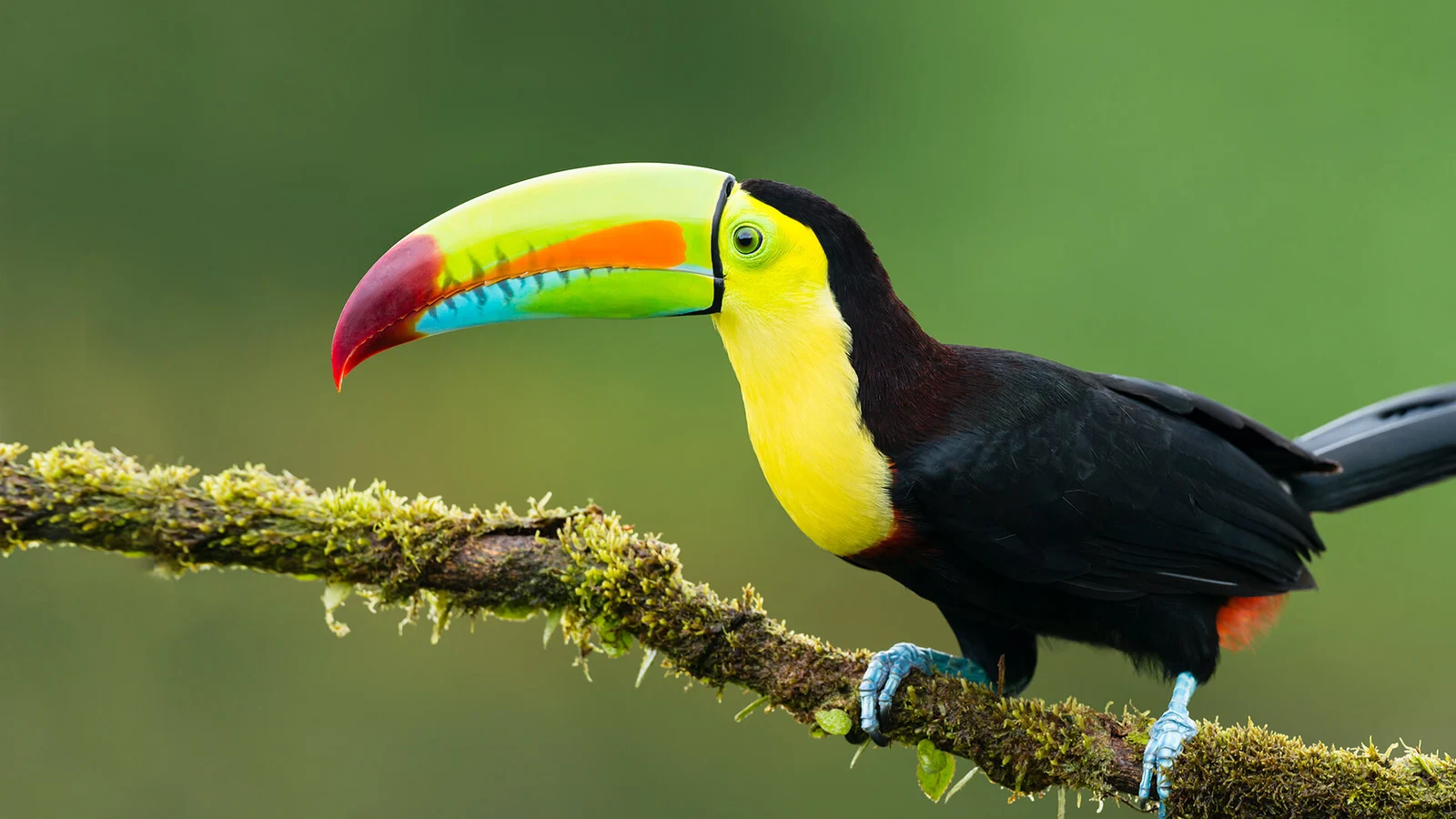
- Toucans — the Yellow-throated Toucan and Black-mandibled Toucan are regular across the forested hills. Most visible in the canopy along the back country loop at dawn.
- Tanagers — the corridor supports a high concentration. Look for the Bay-headed Tanager, Blue-gray Tanager, Palm Tanager, and the locally significant Multicolored Tanager (an Antioquia endemic).
- Hummingbirds — year-round residents. The White-necked Jacobin is common along the reservoir edge. The Sparkling Violetear is the most frequently seen around the town itself. In the cloud forest toward San Rafael, species richness increases substantially.
- Motmots — the Andean Motmot is found in the mid-elevation forest. Distinctive long tail. Usually heard before seen.
- Kingfishers — three species along the reservoir inlets: Ringed, Amazon, and the tiny American Pygmy Kingfisher. Best found on quiet coves away from boat traffic.
- Antbirds and wrens — in the dense understorey. Harder to see but the call density on a morning walk into the forest is remarkable.
- Parrots and parakeets — mixed flocks cross the reservoir at dusk. Orange-chinned Parakeet is common; occasionally Crimson-fronted and other species.
- Raptors — Black Hawk-Eagle and Roadside Hawk are regular; Black Vultures and Turkey Vultures are constant overhead.
Best conditions for birdwatching
- Time: 6am–9am without exception. Activity drops sharply after mid-morning.
- Route: The back country loop roads behind town are the easiest access to bird habitat. A slow early morning ride or walk covers the most species in the least time.
- Season: Resident species are present year-round. Austral migrants supplement the list from October to March. Rainy season can reduce visibility but increases insect activity, which brings birds into the open.
- Equipment: Binoculars are worth carrying. A basic bird app (eBird, Merlin) will help with identification. No guide required for reservoir-edge species; a local guide adds significant value in the forest interior.
Monkeys
The forested hills in the corridor between Guatapé and San Rafael retain enough continuous canopy to support primate populations. Encounters are not guaranteed and depend on where you go and how quietly — but they happen regularly for people who move off the main roads and into the forest.
- Red Howler Monkey (Alouatta seniculus): The most likely primate encounter in this region. Howlers are large, loud, and spend most of the day resting high in the canopy. Their dawn and dusk calls — a deep, resonant roar carrying over a kilometre — are unmistakable. If you hear what sounds like a gale-force wind coming from the forest at 5am, that’s them. Look for them in large fruiting trees at forest edge. The trail corridors behind Guatapé toward San Rafael pass through habitat where resident troops are established.
- Colombian White-fronted Capuchin (Cebus versicolor): More active and visible than howlers. Capuchins move in groups through the mid-canopy, foraging noisily. They’re curious and will sometimes investigate a still observer. Found in secondary forest and at forest-finca boundaries. More likely to be seen mid-morning when they’re active.
- Andean Night Monkey (Aotus lemurinus): Present in this region but rarely seen — strictly nocturnal, small, and cryptic. If you’re staying overnight and moving quietly after dark in forested areas, the large round eyes sometimes reflect a torch beam from a branch overhead.
The best chance of a monkey encounter is on foot or on a mountain bike moving slowly and quietly through the forest trails — not from a vehicle on the main road. Noise and speed push primates back into the canopy before you arrive.
Backcountry mountain biking
The paved roads around Guatapé give you views. The singletrack behind them gives you the forest itself — the same corridors where the toucans cross at canopy level and howlers call at first light. This is what separates a bike ride in Guatapé from almost anywhere else in the region: within 20 minutes of the town center you are in terrain that sees almost no foot traffic.
The Back Country Loop — entry point for everyone
An 18 km guided loop through the backcountry trails directly behind Guatapé. Novice-friendly, no experience required, takes about 2 hours. This is the ride that shows you what’s beyond the reservoir roads. The free community version runs every Monday, Wednesday, and Friday at 7:30am — meeting point in the town center, loaner bikes available, no cost.
(Disclosure: the free ride is run by Mountain Bike Colombia, which is affiliated with GuatapeGuide. We include it because it’s the most accessible way into this terrain, not because of that relationship.)
The Mono Cuco Trail — for those who want to go deeper
19.5 km of wild Andean singletrack. This trail goes where no published guidebook has been — into dense forest above the reservoir, through terrain that requires a guide who knows it well. Limited to 8 riders per group to protect the trail and the experience. Most people who do this ride call it the best of their trip. It is not the introduction — do the back country loop first and see how you feel.
Mountain Bike Colombia → (affiliated with GuatapeGuide)
What the trails actually feel like
- You leave the road, the noise drops, and within minutes the forest closes in. No tour buses, no hawkers, no crowds.
- The terrain is Andean: climbs followed by descents, roots and loose stone, reservoir views that open suddenly between the trees.
- Wildlife encounters happen on bikes because the movement is quiet and unpredictable. Toucans, motmots, and tanagers are regular on the morning rides. Monkeys occasionally.
- You do not need to be a mountain biker. Novice riders complete the back country loop without issue. The Mono Cuco Trail is for people who can handle technical singletrack.
The San Rafael corridor
The road from Guatapé to San Rafael passes through one of the most biologically productive stretches in Antioquia. As you gain elevation the habitat transitions — reservoir edge to secondary forest to cloud forest — and the species list changes with it. San Rafael municipality has dozens of named waterfalls and a river system that supports serious birding. The drive alone, if you stop and look, is worth the 45 minutes.
- By bike: The MBC guided rides extend toward San Rafael on longer formats. The road climbs steadily — this is not a casual pedal but a genuine half-day or full-day commitment on a bike.
- By bus: The San Rafael bus passes Guatapé’s town center and continues up. Flag it at the town center — no terminal needed. Ask the driver to drop you near any trailhead or waterfall access point you’ve identified in advance.
- On foot: The waterfalls near San Rafael are accessible by short hikes from the road. Some require a local guide to find the trail entrance. Ask in San Rafael town itself.
Other wildlife in the corridor
- Glass frogs: Several species are found near the streams and river margins in this corridor. Mostly nocturnal, best found by torchlight near clear fast-moving water. Extraordinary animals — translucent skin, organs visible underneath.
- Caimans: Spectacled Caimans are present in some of the quieter reservoir inlets and river mouths. Seen from boats on longer tours occasionally.
- Snakes: This is tropical forest — snakes exist. Most are non-venomous and not interested in you. On trails, watch where you step and where you put your hands. The risk is low but not zero.
- Butterflies: Outstanding. The Blue Morpho is present; dozens of other species along stream corridors and forest edge. No special effort required — they find you.
- Amphibians: High diversity in the stream systems. Many species are range-restricted and some remain undescribed. This is part of what makes the corridor biologically significant beyond just what’s visible.
PRACTICAL NOTES — JULY 2026
| Best time for wildlife | 6am–9am daily — birds, monkeys most active at dawn |
| Free morning ride | Mon / Wed / Fri, 7:30am — back country loop, town center departure |
| San Rafael by bus | Flag the San Rafael bus at the town center — ~45 min, runs throughout the day |
| What to bring | Binoculars, rain layer, trail shoes, insect repellent, bottled water |
| Tap water | Do not drink it — bring or buy bottled water |
Explore More